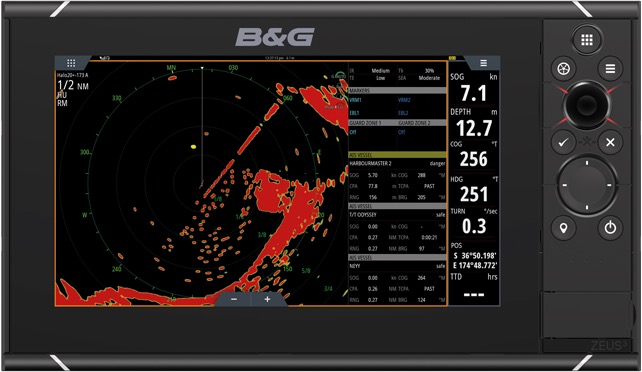
Radar
There was a time when radar would be immediately considered after a chart plotter. These days AIS probably comes first and there will be many yachts that never install a radar and stay with AIS. This is very understandable. A B&G Halo 20+ will set you back £2000. Plus there is the cost and time of installation and cabling to consider, which is challenging. Finally the skill set needed to use it effectively.
Why should I install a radar?
It is an expensive piece of kit. If you sail at night or solo a lot it will be money worth spent. Here’s just a few reasons why
- Not all vessels carry AIS and pieces of land certainly don’t. With a radar you see ALL vessels and obstacles in the area and so…
- Radar is the most reliable way of avoiding collision with other vessels and in poor weather avoiding land also.
- They are invaluable to poor visibility
- They can be used to detect heavy rain quals so you can reef early or steer around them.
- Like AIS they can be set up with alarms and guard zones.
These days power consumption is relatively low. The Halo 20+ I installed is rated at 20W. In standby about 4W and comes out of standby very fast…no waiting for it to warm up.
Which type of radar should I buy?
The technology improvements have been impressive in recent years and it makes sense to get the latest and greatest kit, as there is little in the way of price premium. This means buying a Doppler radar (Doppler pulse compression radar) which is the lastest technology. Most big brands have them and
- They have high definition and are lighter and more efficient than old magnetron units.
- They startup very quickly; no warm up needed.
- At close range they detect buoys and small boats more effectively.
- They can differentiate between stationary object, objects moving away from you and objects moving towards you…showing potentially dangerous vessels in red.
- The MARPA system ( which gives details of speed and closest point and time of approach of other vessels) can track a large number of vessels simultaneously and provides clear information.
Of course you will need a compatible chart plotter to get the best from your radar and you probably already have this. For MARPA to work properly you will need a high quality external direction/heading sensor such as the Raymarine EV-1 or the Navico Precision 9. Do your research first by referring to the supplier website or talk to the company at a boat show. I believe it would be problematic to have a different brand of radar to your plotter and it is likely they won’t connect.
How to install the radar?
You’ll have two things to solve.
– where to mount the radar dome and
-how to route the cables.
You can mount the radar on the front of the mast, taking care that the jib/genoa won’t catch it. Or on a spreader either side of the mast. Or you can mount it on the back stays; Scanstrut make a mount to do this.
You’ll have to run the cable inside the mast or down the backstay and into an entry point towards the rear of the boat.
Neither options are going to be easy, so give it some thought and make sure you order a long enough connection cable. For the B&G there didn’t seem an easy way to extend the powered RJ45 cable and so it had to run from the radar all the way to the plotter. This is going to make it difficult if I have to take the mast down but there seemed to be no other way. If you have the option to extend your connecting cable, route it to the base of the mast or the base of the backstay inside the boat and then add an extra cable from there to the plotter. This will make it easier if you have to take the mast down.
How to set up the radar?
With B&G this was really easy and the manual walked me through the set up. Make sure spend enough time learning how to properly use the radar or take an RYA course. It’s a good idea to regular use the radar even when not needed to keep yourself familiar with it, as I don’t find them intuitive to use and some menu items are hidden deeply. I find a good time to practise is when motoring or when I can see some rain squalls coming. If you have crew make the best use of not being on watch and refresh your radar skills.
Glitches?
I had one and don’t know whether this is B&G related or whether it is because my electronic heading sensor is a Raymarine EV1, ie a different brand.
When the plotter is on first and then the radar is switched on and active, everything initially appears correct. However when I try to use MARPA and guard zones they don’t work correctly. If I switch on the radar first and then the plotter second, MARPA and guard zones work. Very odd but now I know and so do you!
 A Dragon's Tale