Background
In her previous form as Downwind, she was fitted with three bilge pumps:
i) a small electric bilge pump that also featured as a shower drain pump (not automatic).
ii) a manual bilge pump operated from the cockpit.
iii) a high capacity engine driven pump.
These are all good, although for high capacity she is reliant on the engine functioning, so a fouled prop that stopped the engine would put the high capacity pump out of action.
None of these pumps start automatically after detecting water in the bilge and this functionality is something I felt was essential.
Considerations
Before taking the plunge it is worth considering the following
- Pump capacity: I went for the highest capacity that would fit in the space available while also taking into account the diameter of the outlet hose.
- Routing of the outlet hose. Do not overlook this.
– ideally you need to keep the height of pumping (the head) to a reasonable height and well above the waterline.
– smooth bends, no kinks and as short a route as possible.
– in my case the hose outside diameter (OD) was 44mm so the routing was particularly tricky.
– avoid using a non-return valve as this will severely restrict the flow. - Automatic Switch or float switch: there are many to choose from so look around. I went for one recommended by Nigel Calder, the Ultra Pumpswitch. Ultra Pumpswitch
- Mounting the pump and float switch: you need to be able to access the pump and possibly remove easily for cleaning.
- Wiring: ideally you should power the pump directly from the battery via the level control (“float”) switch and float switch and avoid routing the wiring directly in the bilges (of course the wires to the pump and float switch have to go there). Again Calder’s guidance is very practical
Installation
Wiring
Following Nigel Calder’s(i) advice and ran positive and wires of XX via a xxx fuse to a negative bus bar and a positive fuse bank. The theory being that several items can be routed direct to the battery via this cabling, namely a) bilge pump(s), b) solar panel c) wind generator.
I was fortunate that DragonII has built in cable conduit runs, although being tightly packed already, adding a XX cable was bit of a challenge and need two people to push and pull the cable.
The switch to the pump was mounted in a prominent position so when tripped automatically the light would be visible. It is also a good height above the bilges.
Pump
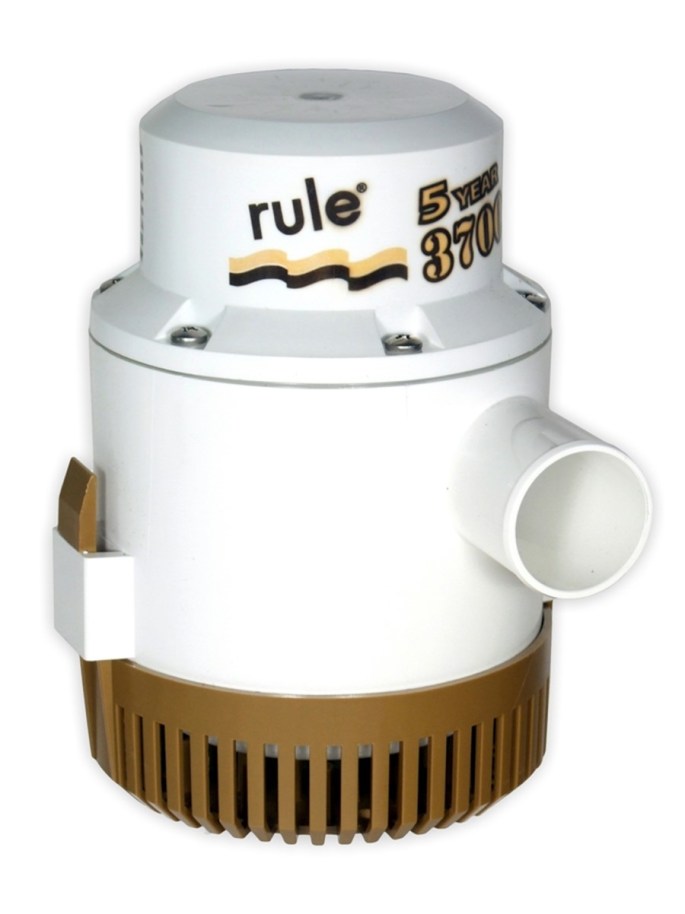
The pump is powerful and needed to be securely mounted. I wanted to be easily remove it and so my plan was to mount it on a board that could slide in and out of the bilge. While this sounds easy, that was not the case. I used two perspex sheets held together with two purpose made stainless steel brackets (see photos). Figuring out the shape of the perspex was tricky, even with a cardboard template, as Dragon II’s bilges are deep and narrow towards the bottom. The fact that that all the work was done on the boat without a “workshop” made it doubly difficult.
Float switch
This was relatively easily mounted on the same boards as the pump although it was a bit of a tight fit due to the narrowness of the bilge.
Hose routing
Frankly this can be a pig. The Malo is built like a tank and routing large hoses through bulkheads was testing. I used both a Bosch plunge saw as well as a powerful drill fitted with a 48 or 50mm drill bit. Be prepare for this to take longer than you would like. Once installed don’t forget to use 2 good quality SS jubilee clips on every hose fastening
Issues/Upgrade
I really wanted to the pump fitted to address a safety concerns. However it does need modifying. The float switch needs raising because in auto mode the pump cycles, that is when the pump switches off, the volume of water in the hoses flows back into the bilge and trips the pump.
Given the time I will also replace the perspex mount with plywood that has been sealed with polyester or epoxy
Details of Rule 3700
5 Year Warranty
- Connections: For 38mm (1.5″) bore hose.
- Dimensions: 180mm high, 135mm base diameter.
- Fuse Size: 20(amp)
- Output: Up to 220 litres/minute (48 gallons/minute). Max. recommended discharge head 4m.
- High capacity pump for larger yachts and motor cruisers.
- Tough plastic body.
- Quick release inlet strainer allows rapid cleaning.
- Motor rated for 2500-hour life.
- Ignition protected.
- For automatic operation use Rule Float Switches.
- 5 Year Warranty
- Actual Weight: 2.81 Kg (Approx. 3.31 Kg packed)
 A Dragon's Tale