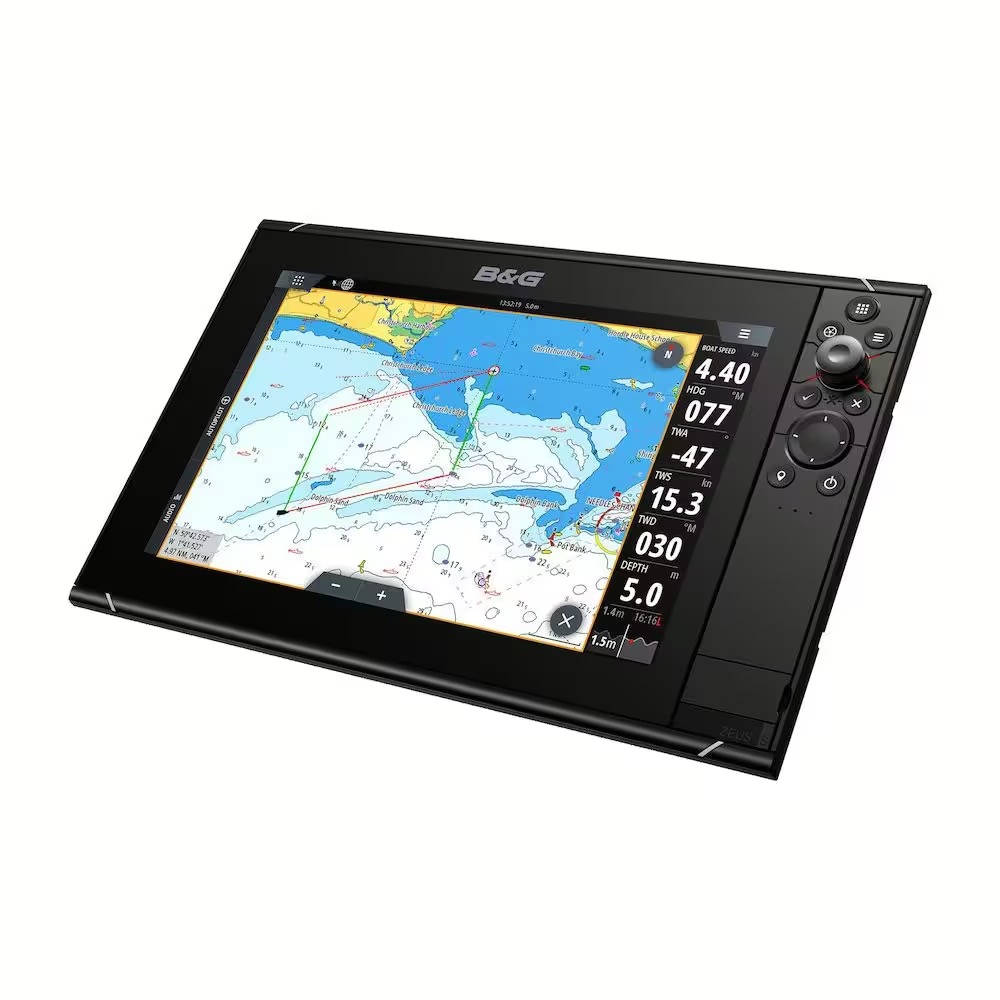
There are a bewildering number of choices from Raymarine, Garmin, B&G and other. They are frequently updating them, so it is hard to give specific recommendations here. Look in the Yachting press for the latest and greatest.
If you want to be sure everything “will talk to each other”, then the safest is to stick with one brand and likely the same as the legacy equipment you want to keep. If this is not for you, jump to mixed brands and learn from my experience. Don’t mix radar and plotter brands. That will almost certainly not work, see mixed brands.
What else to consider?
- Where to mount it? I followed Tom Cunliff’s advise and mounted it down below. I did not want it at the helm as I spend most of my time on autopilot/windvane hiding behind the dodger. I did not want it on a bracket near the companion way…too easy to steal. So down below it went and I can just see it from behind the dodger. If I need something on deck I use a tablet linked to the plotter. I’ve been happy with this choice.
- How big? As big as you can afford and fit in the space available. 12 inches was way too expensive for me, so I stuck to 9 inches and have been happy with my choice.
Chart plotter set up.
This can be time consuming and frustrating. I love my B&G Zeus plotter but I am less enamoured with the manual. You may need to “instruct it” which transducer to use for say “depth” or “SOG”. The only way is to slowly work through it when you are docked and then test thoroughly at sea. Make sure you know all the basics ( YouTube is a good source)
Mixed Brands
see also NMEA and Seatalk networks on this website.
As mentioned, I wanted to stay with Raymarine legacy speed, depth and wind instruments as well as a Raymarine autopilot. When it came to replacing my Raymarine chart plotter, I felt Raymarine were becoming rather inferior for sailors and were instead aiming at the sports fishing market. Some further research led me to B&G Zeus 3S. I also found the B&G Halo Radar had the “doppler” features that originally attracted me to Raymarine Quantum radar.
I could directly connect the B&G Zeus to the Seatalk NG network using a drop cable. A power supply was also needed. I connected the Halo radar into the Zeus plotter using the RJ45 cable (powered) that is supplied with the radar in different lengths. The RJ45 cable needs to have a 12v power source.
I found all the legacy instruments showed on the Zeus but did take some time to get right, with the depth being problematic but solvable. In the depths of the Zeus menu you’ll find how to allocate each transducer to each measurement
The Halo and the Zeus talked to each other, but I did find the following strange anomaly. The radar has both a MARPA[1]function and a guard zone function.
– When the Zeus was powered up first and the radar powered up second, although they appeared to work, both MARPA and guard zone functionality did not work.
– When the Halo was powered up first and the Zeus powered up second, everything including MARPA and guard zone worked as it should.
My solution is to power up Halo first and Zeus second and then in the Zeus controls put the radar in standby. Everything then works. The radar uses little power and is active very fast.
For completeness, you should know the Zeus chart plotter cannot control the Raymarine autopilot. If the autopilot had been B&G, I believe this would have been possible.
[1] MARPA = mini automatic radar plotting aid which calculates the closest point of approach etc.
 A Dragon's Tale